US President Donald Trump is steadily aligning his administration with the crypto industry. On March 20, he addressed a community conference for the first time since being elected.
Speaking at the Blockworks Digital Asset Summit on March 20 in a pre-recorded statement, Trump reiterated that the US would take steps to ensure it is the “crypto capital of the world.”
The president lauded the recent regulatory shift in the crypto industry over the previous administration and added:
“Pioneers like you will be able to improve our banking and payment system and promote greater privacy, safety, security and wealth for American consumers and businesses alike. You will unleash an explosion of economic growth.”
“With dollar-backed stablecoins, you will help expand the dominance of the US dollar for many, many years to come,” the president continued.
President Trump hosted the first White House Crypto Summit, bringing together industry executives to discuss the future of crypto regulatory policy on March 7.
During the meeting, Treasury Secretary Scott Bessent said the US would focus on passing stablecoin regulations and touted stablecoins as a way to ensure the US dollar remains the global reserve currency.
Speaking at the Blockworks Digital Asset Summit, Bo Hines, executive director of the Council of Advisers on Digital Assets, said that a stablecoin bill will likely be presented to President Trump in the next two months.
Treasury Secretary Scott Bessent discusses stablecoin plans at the White House Crypto Summit. Source: The Associated Press
The highly anticipated crypto summit fell short of expectations, with the crypto community voicing mixed reactions to the summit.
Institutional investors and executives tended to characterize the historical nature of the event as a net positive for the industry, while retail investors and the Bitcoin community tended to view the event as underwhelming.
“The White House crypto summit is a gathering of rent-seeking lobbyists pushing state-approved surveillance tokens,” Bitcoin (BTC) maximalist Justin Bechler wrote in an X post.
The price of Bitcoin declined by 7.3% in the days following the White House Crypto Summit and the Bitcoin strategic reserve order, which stipulated that the government could only acquire more BTC through budget-neutral strategies.
The crypto industry is set to debut the first Solana futures exchange-traded fund (ETF), a significant development that may pave the way for the first Solana spot ETF, as the “next logical step” for crypto-based trading products, according to industry watchers.
Volatility Shares is launching two Solana (SOL) futures ETFs, the Volatility Shares Solana ETF (SOLZ) and the Volatility Shares 2X Solana ETF (SOLT), on March 20.
The debut of the first Solana futures ETF may bring significant new institutional adoption for the SOL token, according to Ryan Lee, chief analyst at Bitget Research.
“The launch of the first Solana ETFs in the US could significantly boost Solana’s market position by increasing demand and liquidity for SOL, potentially narrowing the gap with Ethereum’s market cap.”
The Solana ETF will grow institutional adoption by “offering a regulated investment vehicle, attracting billions in capital and reinforcing Solana’s competitiveness against Ethereum,” said Lee, adding that “Ethereum’s entrenched ecosystem remains a formidable barrier.”
Still, other industry participants are concerned that the Solana futures ETF will lead to investor disappointment due to a lack of inflows, as we’ve seen with the spot Ether ETF launch, which was only a “sidekick” to Bitcoin ETFs in terms of inflows, as predicted by Bloomberg’s senior ETF analyst, Eric Balchunas.
Solana futures ETF may see disappointing inflows, but spot Solana ETFs may be next
While the futures ETF may not bring significant inflows, it legitimizes Solana’s status as a top cryptocurrency, especially after US President Donald Trump announced that his Working Group on Digital Assets would include Solana in the US crypto strategic reserve, along with Cardano’s (ADA) token and XRP (XRP).
“Solana ETFs are in motion creating the possible avenues for more wide-scale adoption,” according to Anmol Singh, co-founder of Bullet, a Solana-native perpetual futures decentralized exchange.
Singh told Cointelegraph:
“Solana spot ETF is yet to be approved but given the increased awareness around Solana and the Futures ETFs this would be a logical next step.”
“We can expect moderate inflows into the futures ETF – spot ETF is generally a better instrument for getting exposure and that will be the major milestone,” he added.
While the adoption rate of futures ETFs is difficult to measure, a spot Solana ETF may attract between $3 billion to $6 billion of net assets in the first six months, eclipsing the adoption rate of Ether ETFs, according to a JPMorgan report seen by Cointelegraph.
SOL and XRP ETPs could attract $3–8 billion. Source: JP Morgan
“When applying these so-called “adoption rates” to SOL and XRP, we see SOL attracting roughly $3 billion-$6 billion of net assets and XRP gathering $4 billion-$8 billion in net new assets,” the report stated.
However, “the timeline could extend into 2026 due to the SEC’s precedent of taking […] 240–260 days to review filings,” James Seyffart, Bloomberg Intelligence analyst, said on Jan. 16.
The lion’s share of the hacked Bybit funds is still traceable after the historic cybertheft, as blockchain investigators continue their efforts to freeze and recover these funds.
Blockchain security firms, including Arkham Intelligence, have identified North Korea’s Lazarus Group as the likely culprit behind the Bybit exploit, as the attackers have continued swapping the funds in an effort to make them untraceable.
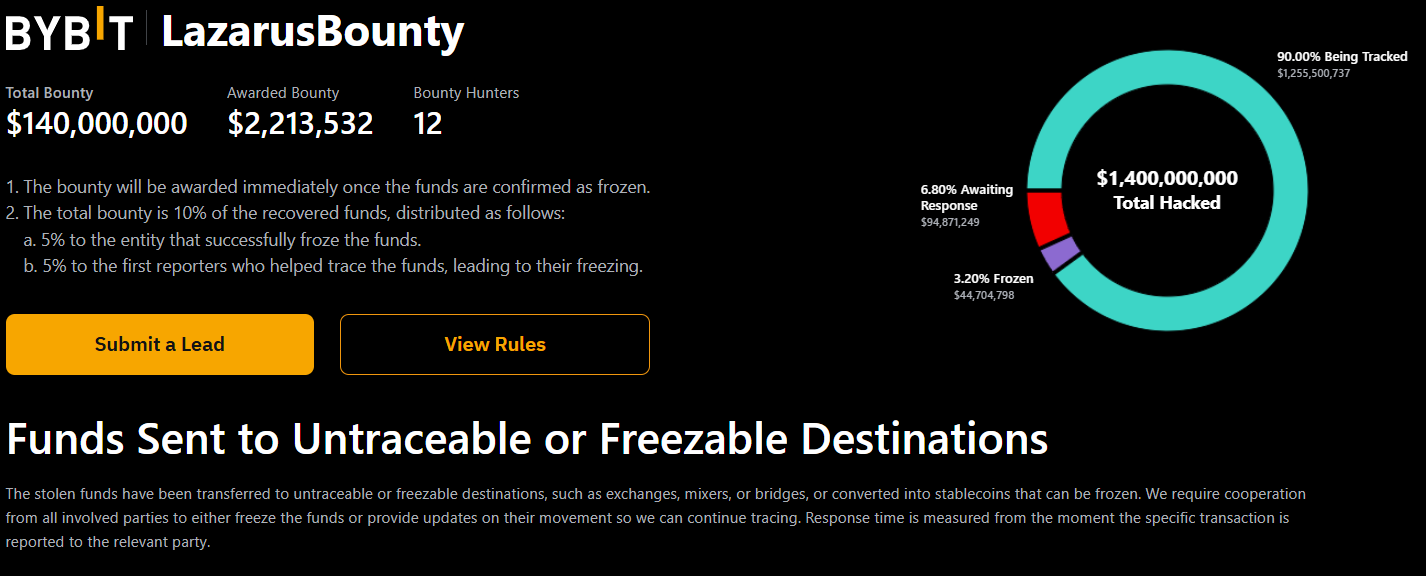
Despite the Lazarus Group’s efforts, over 88% of the stolen $1.4 billion remains traceable, according to Ben Zhou, the co-founder and CEO of Bybit exchange.
“Total hacked funds of USD 1.4bn around 500k ETH. 88.87% remain traceable, 7.59% have gone dark, 3.54% have been frozen.”
“86.29% (440,091 ETH, ~$1.23B) have been converted into 12,836 BTC across 9,117 wallets (Average 1.41 BTC each),” said the CEO, adding that the funds were mainly funneled through Bitcoin (BTC) mixers including Wasbi, CryptoMixer, Railgun and Tornado Cash.
The CEO’s update comes nearly a month after the exchange was hacked. It took the Lazarus Group 10 days to launder 100% of the stolen Bybit funds through the decentralized crosschain protocol THORChain, Cointelegraph reported on March 4.
Still, blockchain security experts are hopeful that a portion of these funds can be frozen and recovered by Bybit.
The crypto industry needs more blockchain “bounty hunters” and white hat, or ethical hackers, to combat the growing illicit activity from North Korean actors.
Decoding transaction patterns through cryptocurrency mixers remains the biggest challenge in tracing these funds, Bybit’s CEO wrote, adding:
“In the past 30 days, 5012 bounty reports were received of which 63 were valid bounty reports. We welcome more reports, we need more bounty hunters that can decode mixers as we need a lot of help there down the road.”
Bybit has awarded over $2.2 million worth of funds to 12 bounty hunters for relevant information that may lead to the freezing of the funds. The exchange is offering 10% of the recovered funds as a bounty for white hat hackers and investigators.
“This incident is another stark reminder that even the strongest security measures can be undone by human error,” Lucien Bourdon, an analyst at Trezor, told Cointelegraph.
Bourdon explained that attackers used a sophisticated social engineering technique, deceiving signers into approving a malicious transaction that drained crypto from one of Bybit’s cold wallets.
The Bybit hack is more than twice the size of the $600 million Poly Network hack in August 2021, making it the largest crypto exchange breach to date.
Crypto exchange Bitnomial has voluntarily dismissed its lawsuit against the US Securities and Exchange Commission ahead of launching its Ripple XRP futures in the United States.
The Chicago-based firm said in a March 19 statement to X that its XRP (XRP) futures are regulated by the US Commodity Futures Trading Commission and will be available from March 20 for current users.
“Bitnomial is launching the first-ever CFTC-regulated XRP futures in the US — physically settled for real market impact,” Bitnomial said.
“Plus, we’ve voluntarily dismissed our case against the SEC as regulatory clarity improves,” it added.
The exchange filed a self-certification with the CFTC to list XRP futures contracts on its exchange in August 2024. However, the SEC blocked the move, pushing for Bitnomial to register as a securities exchange before it could list the futures.
Bitnomial sued the SEC and its five commissioners on Oct. 10, accusing the agency of overextending its jurisdiction by claiming that XRP is a security.
Bitnomial’s XRP futures launch follows Ripple CEO Brad Garlinghouse’s March 19 announcement the SEC opted out of continuing an appeal against a ruling that found XRP is only a security for retail sales.
A July 13, 2023 judgment from Judge Analisa Torres deemed XRP is not a security for retail sales; however, she opined it was when sold to institutional investors, as it met the conditions set in the Howey test. The SEC was appealing Torres’s decision.
The SEC initially launched legal action against Ripple Labs in December 2020, accusing the firm of illegally selling its token as an unregistered security.
The agency’s acting chair, Mark Uyeda, who took the reins after Gensler resigned on Jan. 20, flagged plans on March 17 to scrap a rule proposed under the Biden administration that would tighten crypto custody standards for investment advisers.
Uyeda also said in a March 10 speech that he had asked SEC staff for options to abandon part of proposed changes that would expand regulation of alternative trading systems to include crypto firms, requiring them to register as exchanges.
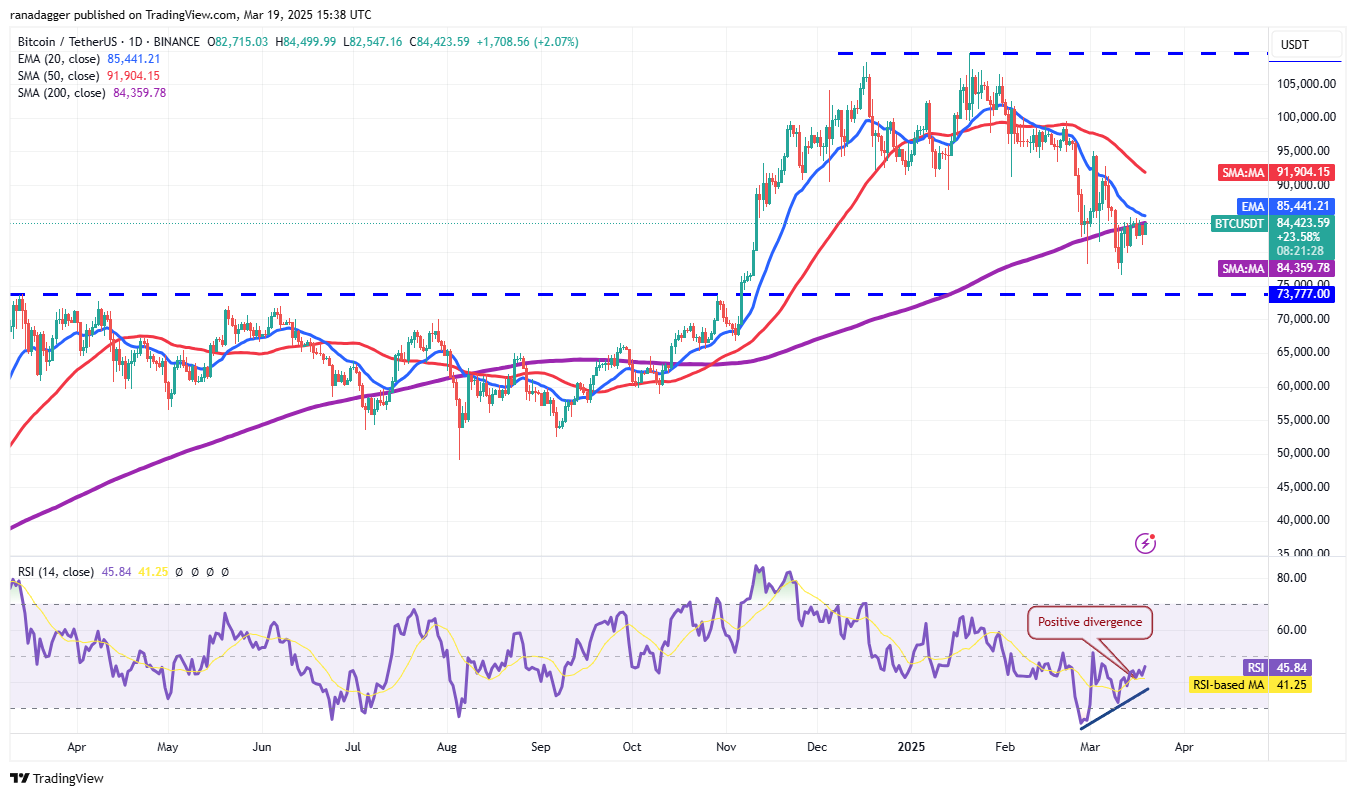
Bitcoin (BTC) has been clinging to the 200-day simple moving average ($84,359), which suggests that the bulls have kept up the pressure. That improves the prospects of an upside breakout, signaling the corrective phase may be ending.
Derive founder Nick Forster told Cointelegraph that the current pullback is a normal correction that Bitcoin experiences during long-term rallies. He anticipates that Bitcoin’s cycle peak is yet to come.
A positive sign in favor of bulls is that the US spot Bitcoin exchange-traded funds (ETFs) have again started to witness inflows. According to Farside Investors data, spot Bitcoin ETFs have recorded $525 million in inflows since March 14.
However, not everyone is bullish on Bitcoin. CryptoQuant founder and CEO Ki Young Ju said in a post on X that Bitcoin could remain in a bearish or sideways trend for the next 6-12 months as the bull cycle is over.
Could Bitcoin break out of the 200-day SMA, triggering a rally in altcoins? Let’s analyze the charts of the top 10 cryptocurrencies to find out.
Bitcoin price analysis
Bitcoin is facing selling at the 200-day SMA, but the bulls have not given up much ground. That suggests the bulls are not dumping their positions as they expect a breakout in the near term.
The bullish momentum is expected to pick up on a break and close above the 20-day exponential moving average ($85,441). The BTC/USDT pair could then climb to the 50-day SMA ($91,904).
This optimistic view will be negated in the near term if the price turns down sharply from the 20-day EMA and breaks below $80,000. The pair may then tumble to $76,606. Buyers are expected to defend the $76,606 to $73,777 zone with all their might.
Ether price analysis
The narrow range trading in Ether (ETH) resolved to the upside on March 19, indicating that the bulls have overpowered the bears.
Sellers will try to halt the relief rally at the breakdown level of $2,111, but if the bulls prevail, the ETH/USDT pair could ascend to the 50-day SMA ($2,468). If this level is also crossed, the pair could surge to $2,850.
Instead, if the price turns down sharply from $2,111, it will signal that the bears are trying to flip the level into resistance. The bears will gain the upper hand if they sink and maintain the price below $1,800.
XRP price analysis
XRP (XRP) surged above the moving averages on March 19, opening the doors for a rally to the resistance line.
If the price turns down from the resistance line, the XRP/USDT pair is likely to find support at the 20-day EMA ($2.36). A bounce off the 20-day EMA increases the likelihood of a break above the resistance line. The pair may then climb to $3.
On the other hand, if the price turns down from the resistance line and breaks below the moving averages, it heightens the risk of a drop to $2. Sellers will be in control on a close below $2.
BNB price analysis
BNB (BNB) closed above the 50-day SMA ($618) on March 17, but the bulls are struggling to sustain the higher levels.
The pullback is expected to find support at the 20-day EMA ($602). If the price rebounds off the 20-day EMA with strength, it will suggest a change in sentiment from selling on rallies to buying on dips. That increases the possibility of a break above $644. The BNB/USDT pair could then rally to $686.
Conversely, a break and close below the 20-day EMA suggests that the bulls are booking profits. That may sink the pair to $550.
Solana price analysis
Solana (SOL) rebounded off the $120 to $110 support zone on March 18, indicating that the bulls are aggressively defending the zone.
If buyers catapult the price above the 20-day EMA ($137), it will suggest the start of a sustained recovery. The SOL/USDT pair could rally to the 50-day SMA ($167) and, after that, to $180.
Contrarily, if the price turns down from the 20-day EMA, it will signal that the bears remain in control. A break below the support zone suggests the start of the next leg of the downtrend. There is minor support at $98, but if the level breaks down, the pair could plummet to $80.
Cardano price analysis
Cardano (ADA) has been trading between the uptrend line and the moving averages for the past few days, indicating indecision about the next directional move.
The downsloping moving averages and the RSI just below the midpoint give a slight edge to the bears. If the price turns down from the moving averages and breaks below the uptrend line, the ADA/USDT pair could drop to $0.58 and eventually to $0.50.
On the contrary, a break and close above the moving averages suggests that the bulls are back in the game. The pair could ascend to $1.02, where the bears are expected to sell aggressively.
Dogecoin price analysis
Dogecoin (DOGE) is facing selling near the 20-day EMA ($0.18), indicating that the bears are active at higher levels.
The bears will try to sink the price below the $0.14 support. If they manage to do that, it will signal the resumption of the downtrend. The DOGE/USDT pair could plunge to psychological support at $0.10.
If buyers do not give up much ground from the current level, it improves the prospects of a break above the 20-day EMA. If that happens, the pair could climb to $0.25 and thereafter to $0.29.
If the price turns down from the 20-day EMA, the bears will again try to sink the LINK/USDT pair below the $12 support. If they manage to do that, the pair could descend to the crucial support at $10.
Alternatively, a break and close above the 20-day EMA suggests that the breakdown below the channel was a bear trap. The pair may climb to the 50-day SMA ($17.22) and later to $19.25.
UNUS SED LEO price analysis
UNUS SED LEO (LEO) has been trading in a tight range between $10 and $9.60 for the past few days, suggesting that the bulls are holding on to their positions as they anticipate a move higher.
If buyers drive and maintain the price above $10, the LEO/USD pair will complete a bullish ascending triangle pattern. The pair may then start an upmove toward the pattern target of $12.04.
Contrary to this assumption, if the price turns down and breaks below $9.60, it will signal that the bulls have given up. The pair may then drop to the uptrend line, which is again expected to attract buyers.
Toncoin price analysis
Toncoin (TON) has been facing resistance at the 50-day SMA ($3.56), but a positive sign is that the bulls have not ceded ground to the bears.
That increases the likelihood of a break and close above the 50-day SMA. If that happens, the TON/USDT pair could climb to $4.50 and then to $5. Sellers are expected to mount a vigorous defense near $5.
This positive view will be invalidated in the near term if the price turns down and breaks below the 20-day EMA ($3.26). That will indicate selling at higher levels. The pair may then slump to $3.
This article does not contain investment advice or recommendations. Every investment and trading move involves risk, and readers should conduct their own research when making a decision.
Volatility Shares is launching two Solana (SOL) futures exchange-traded funds (ETFs), the Volatility Shares Solana ETF (SOLZ) and the Volatility Shares 2X Solana ETF (SOLT), on March 20.
According to the Securities and Exchange Commission filing, SOLZ will feature a management fee of 0.95% until June 30, 2026, when the management fee will increase to 1.15%.
Volatility Shares’ 2X Solana ETF gives investors twice the leverage and will feature a 1.85% management fee.
For context, Bitcoin (BTC) futures debuted at over $102 million in volume on the first day of trading, and Ether (ETH) futures garnered over $30 million the day they launched.
Despite the relatively low volume, SOL futures contracts could help boost demand for the cryptocurrency from institutional investors and encourage price discovery.
The launch of SOL futures signaled the approval of SOL ETFs in the United States as financial regulators embrace digital assets amid a policy pivot.
According to Chris Chung, founder of Titan — a Solana-based swap platform — the CME’s futures indicate that SOL is now a mature asset capable of attracting institutional interest.
Chung added that the launch of SOL futures and ETFs position Solana as a blockchain network poised for real-world use cases such as payments, not just a memecoin casino.
ETFs could also allow investor capital to flow into SOL, creating a sustained rally in the altcoin that competitors lacking an ETF might miss out on.
The launch of Bitcoin ETFs in 2024 is widely believed to have siloed institutional capital away from the rest of the crypto market, preventing capital rotation from BTC into altcoins and upending altseason.
Solana’s native token, SOL (SOL), rose 8% on March 19 as investors turned to riskier assets ahead of US Federal Reserve Chair Jerome Powell’s remarks. While interest rates are expected to stay unchanged, analysts anticipate a softer inflation outlook for 2025. Meanwhile, key onchain and derivatives metrics for Solana suggest further upside for SOL price.
The cryptocurrency market mirrored intraday movements in the US stock market, suggesting SOL’s gains were not driven by industry-specific news, such as reports that the US Securities and Exchange Commission may drop its lawsuit against Ripple after clinging to it for four years.
Russell 2000 small-cap index futures (left) vs. SOL/USD (right). Source: TradingView / Cointelegraph
On March 19, the Russell 2000 index futures, tracking US-listed small-cap companies, surged to their highest level in twelve days. Despite a broader slowdown in decentralized application (DApp) activity, Solana stands out.
Solana’s TVL continues to rise
Solana’s onchain volumes dropped 47% over two weeks, but similar declines were seen across Ethereum, Arbitrum, Tron, and Avalanche, highlighting industry-wide trends rather than Solana-specific issues. The Solana network’s total value locked (TVL), a measure of deposits, hit its highest level since July 2022, supporting SOL’s bullish momentum.
Solana total value locked (TVL), SOL. Source: DefiLlama
On March 17, Solana’s TVL climbed to 53.2 million SOL, marking a 10% increase from the previous month. By comparison, BNB Chain’s TVL rose 6% in BNB terms, while Tron’s deposits fell 8% in TRX terms over the same period. Despite weaker activity in decentralized applications (DApps), Solana continued to attract a steady flow of deposits, showcasing its resilience.
Solana saw strong momentum, driven by Bybit Staking, which surged 51% in deposits since Feb. 17, and Drift, a perpetual trading platform, with a 36% TVL increase. Restaking app Fragmentic also recorded a 65% rise in SOL deposits over 30 days. In nominal terms, Solana secured its second-place position in TVL at $6.8 billion, ahead of BNB Chain’s $5.4 billion.
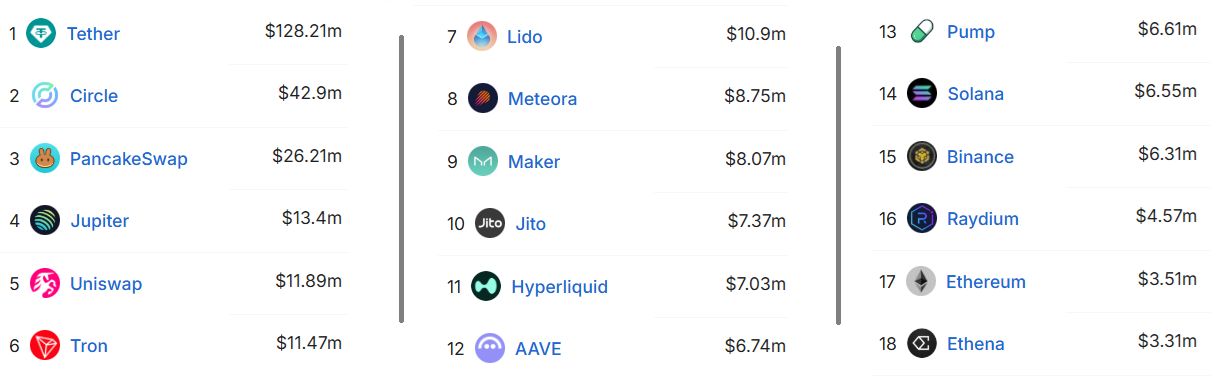
Despite the market downturn, several Solana DApps remain among the top 10 in fees, outperforming larger competitors like Uniswap and Ethereum’s leading staking solutions.
Ranking by 7-day fees, USD. Source: DefiLlama
Solana’s memecoin launchpad Pump.fun, decentralized exchange Jupiter, automated market maker and liquidity provider Meteora, and staking platform Jito are among the leaders in fees. More notably, Solana’s weekly base layer fees have surpassed Ethereum’s, which holds the top position with $53.3 billion in TVL.
SOL derivatives hold steady as token unlock fears subside
Despite a 27% decline in SOL’s price over 30 days, demand for leveraged positions remains balanced between longs (buyers) and shorts (sellers), as indicated by the futures funding rate.
SOL futures 8-hour funding rate. Source: CoinGlass
Periods of high demand for bearish bets typically push the 8-hour perpetual futures funding rate to -0.02%, which equals 1.8% per month. When the rate turns negative, shorts are the ones paying to maintain their positions. The opposite occurs when traders are optimistic about SOL’s price, causing the funding rate to rise above 0.02%.
The recent price weakness was not enough to instill confidence in bears, at least not to the extent of adding leveraged positions. One reason for this can be explained by the reduced growth in SOL supply going forward, similar to inflation. A total of 2.72 million SOL will be unlocked in April, but only 0.79 million are expected for May and June.
Ultimately, SOL is well-positioned to reclaim the $170 level last seen on March 3, given the resilience in deposits, the lack of leverage demand from bears, and the reduced supply increase in the coming months.
This article is for general information purposes and is not intended to be and should not be taken as legal or investment advice. The views, thoughts, and opinions expressed here are the author’s alone and do not necessarily reflect or represent the views and opinions of Cointelegraph.
Crypto regulations must be enacted through an act of Congress to become permanent and meaningful pieces of legislation, according to former Congressman Wiley Nickel.
In an exclusive video interview with Cointelegraph’s Turner Wright, Nickel urged bipartisan collaboration to push through comprehensive crypto regulations. The former Congressman added:
“I think it’s really important for anybody who cares about this issue to step back and realize that if you want lasting change in Washington, you must move legislation through Congress. Otherwise, if you’re talking about executive orders, it will just go back and forth.”
“You don’t want to have the mess that we saw just months ago with Gary Gensler’s SEC — you need to get legislation through Congress,” Nickel reiterated.
Both chambers of Congress rush to push through meaningful legislation
Rep. Tom Emmer, the majority whip of the United States House of Representatives, reintroduced legislation banning a CBDC in the US on March 6.
Wyoming Senator Cynthia Lummis also reintroduced the Bitcoin Act in March, which builds upon an earlier bill of the same title but allows the US to purchase more than 1 million Bitcoin (BTC).
Rep. Byron Donalds recently announced that he would draft legislation to codify the Bitcoin strategic reserve into law — shielding President Trump’s original executive order from being overturned by a future administration.
On March 12, the House of Representatives repealed the IRS broker rule requiring decentralized finance platforms to report information to the Internal Revenue Service in a 292-131 vote.
Speaking at this year’s Blockworks Digital Asset Summit, Democrat Rep. Ro Khanna said that Congress should be able to pass comprehensive crypto regulation in 2025, including a stablecoin bill and a market structure bill.
The US Securities and Exchange Commission’s dismissal of its years-long lawsuit against Ripple Labs, the developer of the XRP Ledger blockchain network, is a “victory for the industry,” Ripple CEO Brad Garlinghouse said at Blockworks’ 2025 Digital Asset Summit in New York.
Earlier on March 19, Garlinghouse revealed that the SEC would dismiss its legal action against Ripple, ending four years of litigation against the blockchain developer for an alleged $1.3-billion unregistered securities offering in 2020.
“It feels like a victory for the industry and the beginning of a new chapter,” Garlinghouse said on March 19 at the Summit, which was attended by Cointelegraph.
Ripple’s CEO said the SEC is dropping its case against the blockchain developer. Source: Brad Garlinghouse
The dismissal is the latest — and arguably most significant — reversal by the SEC under US President Donald Trump.
The agency previously dropped charges against other crypto firms, including Coinbase, Kraken and Uniswap, for similar alleged securities law violations.
Under former President Joe Biden, the SEC brought upward of 100 enforcement actions against crypto firms, typically alleging failure to properly register products that former SEC Chair Gary Gensler said fell under the securities regulators’ jurisdiction.
Trump has taken a friendlier stance toward the burgeoning industry, promising to make America the “world’s crypto capital” and appointing industry-friendly leaders to key regulatory posts.
“The new chapter started with the reset at both the Congress and the executive branch […] when Trump came in and nominated Paul Atkins, Scott Bessent, [and] brought on David Sacks,” Garlinghouse said.
Trump nominated Atkins and Bessent to head the SEC and Treasury Department, respectively. Sacks is Trump’s artificial intelligence and “crypto czar,” a newly created White House advisory role.
“I really deeply believed that we were going to be on the right side of the law and on the right side of history,” Garlinghouse said of his company’s protracted legal fight with US regulators, adding that, in his view, the SEC was “just […] trying to bully” the crypto industry.
Now that regulatory headwinds have subsided, Ripple is focusing on expansion, Garlinghouse added.
“Ripple has invested over $2 billion in investments and acquisitions across the crypto landscape, and some of those have nothing to do with XRP because if crypto does well, I fundamentally believe Ripple will do well,” he said.
Cardano’s (ADA) price has managed a steady 13.5% in March after experiencing a 32% dip in February. The altcoin is still down 15% in Q1, but technical data is beginning to point to the continuation of the recent positive price action.
Despite ADA price moving sideways between $0.78 and $0.70 over the past 10 days, social sentiment related to the altcoin has hit a new year-to-date high.
Cardano’s “bullish” sentiment soars to 4-month high
According to Santiment, an onchain intelligence platform, Cardano’s social sentiment exhibited its highest positive measurement in four months.
ADA investors received a boost from the US Securities and Exchange Commission’s (SEC) recent comments, which classified Cardano’s use case as “smart contracts for government services.” The SEC statement was followed by ADA’s highest ratio of positive comments since the first week of November 2024.
Cardano’s crowd sentiment score by Santiment. Source: X.com
A rise in social sentiment is often aligned with increased trading activity and, at times, higher prices. In Q4 2024, a rise in positive social sentiment and active transactions went hand in hand for ADA. However, the environment is slightly different right now.
Data from Cardanoscan.io showed a stark difference between the number of active transaction counts from early November 2024 and now. In Q4, the average transaction count remained above 100,000 for most of November and December, but currently, it is roughly down 70%, with the number of transactions coming in at 26,437 on March 18.
Daily transaction count and fees chart. Source: cardanoscan.io
Regardless of the weak onchain activity, Michael Heinrich, CEO of 0G Labs, told Cointelegraph that Cardano’s strength lies in “lobbying” its community. Speaking on ADA and XRP’s inclusion in a US Digital Asset Stockpile, Heinrich said,
“They have time in the game: these tokens have been around for a while, they’re liquid, and they’re unlikely to spring any sudden surprises.”
Irrespective of the underwhelming onchain data, ADA price has been receptive to positive news in the past.
The altcoin has maintained a position above the 0.50 Fibonacci retracement line despite ADA being in a downtrend since its 2024 high of $1.32. This indicates that ADA’s high-time frame (HTF) chart remains on a technical uptrend.
ADA/USDT 1-day chart. Source: TradingView
Cardano retained support from the ascending trendline (black line) while oscillating between its parallel channel. Currently, the immediate resistance lies at the upper range of the channel at $0.78, which is supported by the 200-day exponential moving average (200-DEMA, orange line). A positive candle close above the 200-DEMA on the daily chart indicates a bullish shift, potentially triggering a move above $0.78.
The immediate target above $0.78 lies between 0.84 and $0.88, where a daily fair value gap (FVG) is present. A retest of $0.88 marks a 20% return from its current price.
However, historically, Cardano has exhibited prolonged sideways movement, which could limit immediate gains. A break above $0.78 validates further confirmation for a rally, but until then, the altcoin may continue to range between $0.78 and $0.70.
This article does not contain investment advice or recommendations. Every investment and trading move involves risk, and readers should conduct their own research when making a decision.